Working with talent from LATAM offers more than time zone alignment—it brings diversity of thought and fresh perspectives into your team. Professionals from Latin America often approach problems differently, challenge assumptions, and contribute creative ideas shaped by diverse cultural and business environments. This diversity leads to stronger problem-solving, more innovation, and teams that don’t just execute tasks, but add real strategic value.
At the same time, LATAM talent delivers a clear economic and operational advantage. Companies access highly skilled professionals at a more efficient cost, while benefiting from cultural compatibility and shared working hours.
In the next sections, we’ll explore how time zone alignment and nearshore outsourcing with LATAM talent turn these advantages into faster collaboration, better leadership flow, and a true competitive edge.

Table of Content
What Time Zone Alignment Really Means
Why Time Zone Alignment Matters Today
How to Take Advantage of Time Zone Alignment
When Is the Right Time to Start?
Why Nearshore Outsourcing with LATAM Talent Works
The Real Advantage
Q&A
1. What Time Zone Alignment Really Means
Time zone alignment means your team works during the same hours you do. Questions get answered the same day, decisions don’t wait overnight, and work keeps moving.
When teams don’t share working hours, progress slows down. Not because people aren’t good—but because everything takes longer than it should.
Time zone alignment isn’t about clocks. It’s about keeping momentum.
2. Why Time Zone Alignment Matters Today
More companies are hiring remotely than ever before. Talent is global, teams are distributed, and speed matters.
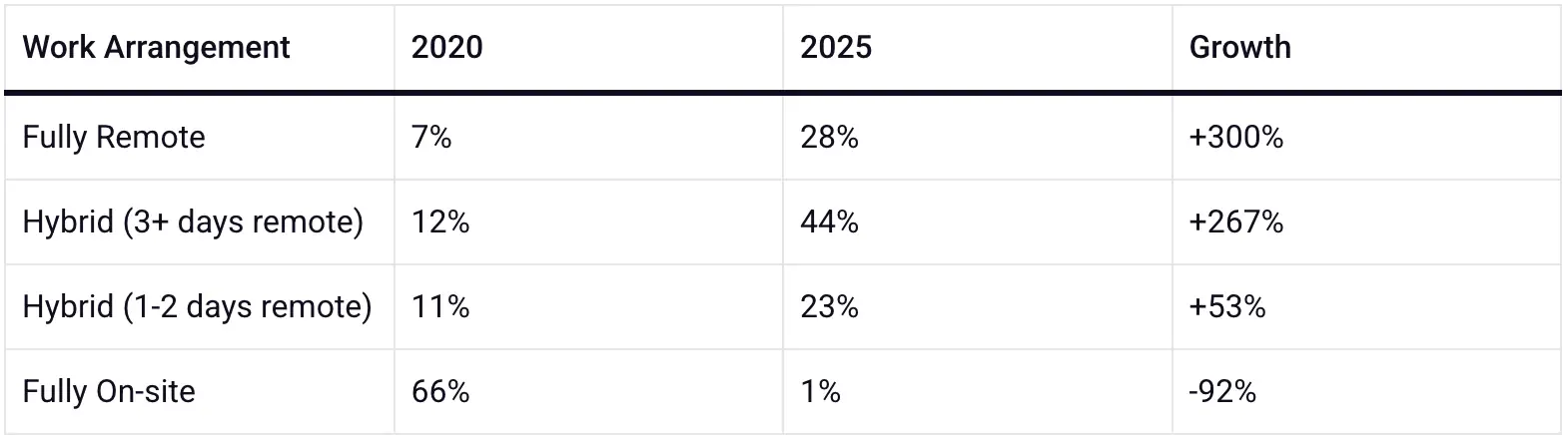
Source: Secondtalent
This chart offered by Secondtalent illustrates the rapid transformation of work models over the past five years. By 2025, the majority of companies operate with distributed or hybrid teams, reflecting a structural shift toward flexibility, global talent access, and faster hiring cycles.
The problem is that most businesses still need real-time collaboration. They rely on fast feedback, live decisions, and daily coordination. Large time gaps make this harder.
That’s why time zone alignment has become a competitive advantage—not a nice-to-have.
3. How to Take Advantage of Time Zone Alignment
Time zone proximity only works if you use it intentionally. Here’s where aligned teams win.
1. Real-Time Collaboration
When your team is online at the same time, small questions don’t turn into full-day delays. Problems are solved when they appear, not after they grow.
This is especially important for executive support, operations, and customer-facing roles.
Related: Soft Skills Remote Work: How Human Connection Drives Virtual Team Performance
Related: From Assistant to Ally: How VAs Drive Strategic Business Impact
2. Faster Feedback Loops
Work improves faster when feedback happens the same day. Corrections stick, context stays fresh, and quality goes up naturally.
Aligned time zones shorten feedback loops—and faster loops lead to better results.
Related: The ROI of Hiring Proactive Virtual Assistants
Related: How Nearshore VAs Are Empowering Small Business Growth
3. Better Use of Leadership Time
Managing a team shouldn’t require working nights or early mornings. When teams share working hours, leaders can stay involved without burning out.
Time zone alignment makes good leadership sustainable.
Related: Creative Delegation: The Key to Unlocking Your Team’s Potential
Related: Productivity Strategies Business Leaders Use: The VA Delegation Framework
4. Stronger Team Integration
Culture is built through daily interaction. Shared hours make collaboration feel natural and help remote team members integrate faster.
Related: Virtual Assistant Retention 2025: 7 Proven Strategies to Keep Top Talent Long-Term
Related: The Human Advantage: Why Emotional Intelligence Is a Virtual Assistant’s Best Skill
4. When Is the Right Time to Start?
Most companies wait too long to fix time zone friction.
If execution feels slower than it should, if communication requires too many handoffs, or if leaders feel stretched managing across time gaps—time zone alignment is already costing you.
The best time to address it is before it becomes operational debt.
5. Why Nearshore Outsourcing with LATAM Talent Works
Latin America offers a rare combination: strong talent, cultural alignment, and overlapping work hours with the U.S.
For U.S. companies, this usually means a 0–3 hour difference. For European teams, it creates real collaboration windows instead of full-day gaps.
At Avila VA, we’ve been building time-aligned remote teams since 2016. We don’t just send resumes—we match businesses with Virtual Assistants who fit their pace, culture, and working hours.
Our process is simple by design: clear discovery, fast candidate matching, live interviews, structured onboarding, and ongoing performance support.
Because time zone alignment only works when the right people are supported the right way.
Related: Nearshore Outsourcing Benefits: 7 Reasons Why Companies Choose Latin America Over Asia
Related: Nearshore vs Offshore: The Ultimate Comparison for Outsource Staffing Agencies in 2025
6. Where Speed Actually Breaks or Scales
Most delays in growing companies don’t come from lack of talent. They come from handoffs.
Every time work crosses a time zone, you introduce latency:
questions answered a day later
feedback arriving when the context is already gone
decisions postponed, not because they’re hard, but because people aren’t available at the same time
Nearshore outsourcing reduces that latency, not by working faster—but by shortening the decision loop. And when teams operate in the same or overlapping time zones:
problems are solved in hours instead of days
collaboration happens synchronously, not asynchronously by default
execution improves because alignment happens in real time
Shorter loops lead to faster iterations. Faster iterations lead to better outcomes. The real advantage isn’t cost, it’s operational velocity without organizational friction.
In markets where speed determines who learns first and adapts fastest, time zone alignment isn’t a preference—it’s an architectural choice.
Related: How AI and Nearshore Hiring Are Transforming the Job Market
7. Questions & Answers
-
It means your remote team works during the same hours you do, enabling faster communication and real-time collaboration.
-
Because it eliminates delays, speeds up decisions, and keeps work moving without overnight pauses.
-
It shortens feedback loops, resolves issues immediately, and prevents small questions from becoming full-day blockers.
-
As soon as communication feels slow, leadership feels stretched, or progress depends on too many handoffs.
-
LATAM offers strong talent, cultural alignment, and overlapping work hours with U.S. and European teams.
Ready to eliminate time zone friction and build a faster, fully aligned remote team?
Book a discovery call with Avila VAExplore nearshore staffing solutions designed for real-time collaboration and sustainable growth.