

Table of Contents
The Global Shift: Why U.S. Companies Are Hiring VAs from Latin America
What Makes LATAM the Best Region for Remote Work (and USD Income)
The Skills U.S. Companies Want Most — According to WEF
How to Become a Virtual Assistant for U.S. Companies
Earning Potential: How Much Can You Really Make?
Why U.S. Companies Prefer LATAM Over Other Regions
AI Skills Will Decide Who Gets Hired Next
Conclusion
Q&A
For years, professionals across Latin America imagined a career that offered flexibility, financial freedom, and the chance to contribute their talent on a global stage. Today, this is no longer a distant possibility — it’s one of the fastest-growing career paths in the region.
Thousands of people are now landing remote virtual assistant jobs in the USA, building sustainable income streams, and discovering how to earn in dollars from Latin America while working entirely from home.
What changed?
Two things:
U.S. companies are in a historic talent shift.
Latin America is perfectly positioned to fill the gap.
And the World Economic Forum’s Future of Jobs Report 2025 reveals exactly why this opportunity is exploding right now.
1. The Global Shift: Why U.S. Companies Are Hiring VAs from Latin America
The WEF highlights a striking pattern: North America is facing one of the highest upskilling gaps in the world — 67% of workers will need new skills by 2030. This skills gap creates two immediate realities:
1. U.S. companies need remote talent. Fast.
Startups, e-commerce brands, digital coaches, agencies, and service-based businesses cannot find enough support talent locally.
They’re turning abroad — especially for:
admin support
operations
customer experience
project coordination
digital organization
executive assistance
Exactly the roles Latin Americans excel in — which is why virtual assistant jobs in Latin America are multiplying.
2. LATAM has the skills the U.S. lacks.
According to the WEF, Latin America leads globally in:
people skills (empathy, communication, adaptability)
resilience and situational awareness
ability to integrate technology quickly
service orientation
This combination is extremely rare. And extremely valuable.
Related: How Nearshore VAs are Empowering Small Business Growth
2. What Makes LATAM the Best Region for Remote Work (and USD Income)
The WEF’s regional data shows that LATAM has:
377 million working-age adults
a skyrocketing digital adoption rate
one of the fastest-growing remote-work cultures
strong alignment with U.S. time zones
This is why so many professionals are beginning to work for U.S. companies from Latin America while staying close to their families and improving their financial stability.
Related: Nearshore Outsourcing Benefits: 7 Reasons Why Companies Choose Latin America Over Asia
The trend is undeniable. Remote work in Latin America is becoming a long-term economic engine — especially for support and operations roles.
3. The Skills U.S. Companies Want Most — According to WEF
The WEF highlights the top skills employers worldwide will demand by 2030. These perfectly match the skills of high-performing virtual assistants.
Hard Skills (Technical)
Highly relevant virtual assistant skills for US clients include:
Google Workspace mastery
tech literacy
CRM management
digital platforms (Notion, Slack, ClickUp)
documentation and process design
basic content editing
The WEF ranks “technological literacy” as one of the top 3 must-have skills globally.
Soft Skills (Professional)
Here is where Latin America shines.
The WEF ranks these among the most in-demand skills:
adaptive thinking
communication clarity
self-management
collaboration and empathy
proactive problem solving
These are exactly the productivity skills for virtual assistants that make U.S. founders say:
“We prefer hiring from Latin America. They communicate better, they problem-solve faster, and they think like partners.”
This alignment is the secret behind the rise of Latin American virtual assistants.
Related: VA Software Skills 2025: Top 10 Certifications That Increase Your Rate by 30%
4. How to Become a Virtual Assistant for U.S. Companies
You don’t need a perfect résumé or flawless English. What you need is clarity.
Step 1: Choose your path
Your first step is choosing a path. You don’t need a long-term specialization—just an initial direction that matches your strengths and experience.
Admin VA
Customer Support VA
Operations VA
Social Media VA
E-commerce VA
Paralegal
VA for creatives or coaches
This is your entry point into remote jobs for Latin American professionals.
Step 2: Build your professional profile
Before applying, your professional presence must clearly show who you are and what you can deliver. These four elements are your first impression—and they need to work.
English résumé
LinkedIn optimized
Portfolio (simple but clean)
Short pitch message
Related: Best Virtual Assistant Training Courses for 2025
Related: How to Build a Standout LinkedIn Profile in 2025
Step 3: Build tool confidence
Organization is about building reliable organization systems for VAs that support both clients and their growing workloads.
Related: From Chaos to Control: Essential VA Organization Tools Every Professional Needs
Related: Become a VA Pro: Essential Tools, Communities & Habits
Step 4: Apply strategically
The best places to find virtual assistant jobs in Latin America include:
remote-first startups that actively recruit international talent
nearshore hiring platforms connecting LATAM professionals with U.S. companies
specialized VA agencies that place assistants directly inside U.S. operations
LinkedIn communities where founders and hiring managers post real-time needs
Rather than applying blindly to hundreds of listings, this targeted ecosystem is exactly how Latin American VAs break into U.S. startups—without getting lost in crowded job boards or competing with thousands of applicants.
Related: How to Land Remote Administrative Assistant Jobs (Even Without Years of Experience)
5. Earning Potential: How Much Can You Really Make?
One of the top reasons professionals pursue remote work in Latin America to earn in USD is financial stability.
Realistic monthly ranges:
Entry-level: $700–$1200
Experienced: $1200–$1800
Advanced/specialized: $1800–$2500
Roles that pay the most:
Executive Assistance
Operations Support
Customer Success
Marketing VA
Project Coordinator
Related: Specialized VA Roles That Pay More in 2025 (And How to Land One)
Related: How to Price Yourself as a Virtual Assistant in 2025: Tools, Roles, and Remote Realities
In other words: You can absolutely earn in dollars from Latin America sustainably.
6. Why U.S. Companies Prefer LATAM Over Other Regions
The World Economic Forum’s Future of Jobs Report 2025 reveals a global labor market undergoing one of the fastest skill transformations in modern history. With 39% of all core skills expected to change by 2030 and North America experiencing one of the steepest reskilling gaps worldwide, U.S. companies are increasingly relying on remote talent capable of adapting quickly, mastering digital tools, and offering strong human-centric skills such as communication, problem-solving, empathy, and self-management.
Latin America, coincidentally — or strategically — aligns perfectly with this shift. The region is experiencing rapid digital adoption, a growing remote-work culture, and a workforce known for its collaborative, resilient, relationship-driven approach.
And the market reality is clear: the combination of rising digital capacity, human-centric strengths, and time-zone compatibility is turning Latin America into one of the most strategic talent hubs for U.S. companies.
7. AI Skills Will Decide Who Gets Hired Next
The latest WEF data shows something unmistakable: AI literacy is about to become as basic as email literacy was 15 years ago.
Here’s what the trend reveals:
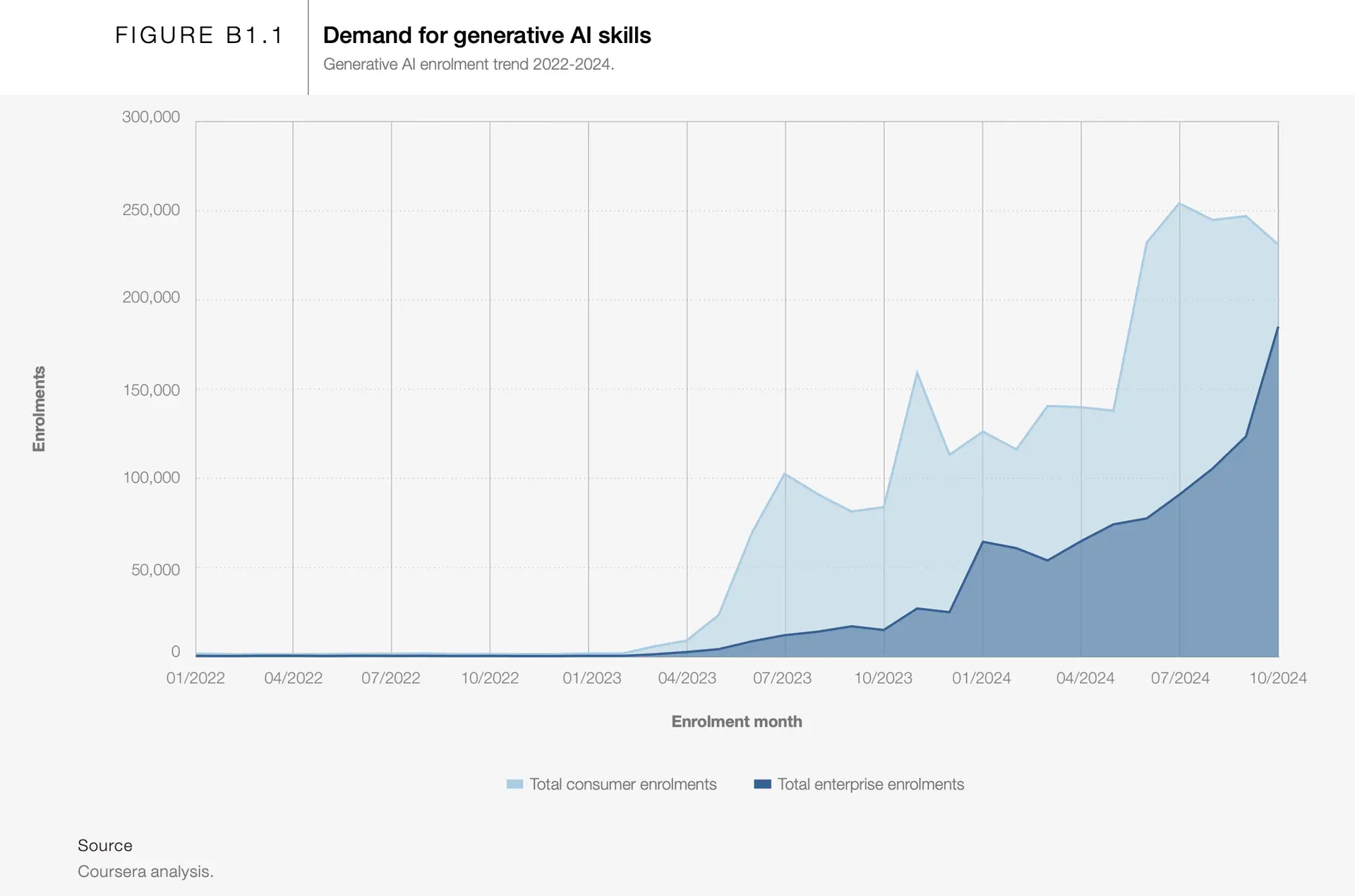
Generative AI skills are exploding in demand, with global enrollments growing faster than any other skill category in the past decade.
Individuals are training in prompt design, trustworthy AI practices, and AI-driven decision-making.
Companies are prioritizing practical, productivity-focused automation skills that deliver immediate results.
And here’s the uncomfortable truth no one tells VAs:
U.S. companies will soon expect virtual assistants to work confidently alongside AI—not as a nice-to-have, but as the baseline.
If the trend continues (and every indicator says it will):
VAs who embrace AI will climb the income ladder, secure better roles, and become indispensable.
VAs who resist it may become irrelevant, not because AI replaces them, but because AI will amplify the ones who know how to use it.
AI isn’t replacing VAs; it’s upgrading the smart ones.
Related: Beyond the AI Hype: Why Human Intelligence Drives Real Growth
Related: AI-Enhanced Virtual Assistants 2025: How Human + AI Teams Drive 3x Business Efficiency
8. Conclusion
We are witnessing the rise of a new global workforce — one where geography is irrelevant, USD income is accessible, and Latin American Virtual Assistants are rewriting what career growth looks like.
The data is undeniable:
U.S. companies are not just open to hiring internationally — they are depending on it
LATAM is uniquely positioned to fill that gap with a rare mix of human-centric skills, resilience, cultural alignment, and fast digital adaptation.
But here’s the part the WEF doesn’t explicitly say: The next generation of top-earning VAs won’t just be organized or tech-savvy. They will be:
AI-literate
adaptable
emotionally intelligent
proactive thinkersstrategic partners
cross-cultural communicators
In other words: the VAs who treat this career as a profession — not a placeholder — will dominate the market.
If you prepare now, if you build the right skills, if you understand the direction the world is moving…
Then five years from today, you won’t just be “working remotely.” You will be part of a global talent class that earns in dollars, partners with high-growth companies, and shapes the future of digital work across continents.
And if you're ready to begin that journey, there has never been a better moment.
👉 Apply to work with us and take the first step toward your global career.
9. Q&A
-
No, you need functional, clear communication. Most U.S. founders prefer clarity and reliability over perfect grammar.
-
For prepared candidates: 2–8 weeks. For beginners building profiles and skills: 2–3 months.
-
AI literacy, CRM management, high-level organization, and proactive communication.
-
Yes. Many U.S. startups hire based on attitude, adaptability, and willingness to learn, not past remote experience.
-
No, it will shift. VAs who use AI will earn more. VAs who ignore it will become replaceable.